If night driving in Greater Boston feels harder than it did ten years ago, that’s biology plus equipment, and both halves have fixes. There’s also a local multiplier: from November through January the sun sets between 4 and 4:30 here, so “night driving” includes the grocery run, the commute home, and everything after lunch feels close behind. This is a practical guide, not a lecture: what actually changes with your eyes after 60, which local roads make it worst, and the highest return fixes in order.
What actually changes with your eyes?
Three things, all gradual. The pupil shrinks with age and lets in less light, so a 60 year old retina receives a fraction of the light a 20 year old’s does under the same headlights. The lens inside your eye yellows and scatters light, which turns oncoming headlights into starbursts and glare. And contrast sensitivity declines, so a pedestrian in dark clothes against dark pavement takes longer to register. None of this means you should stop driving at night. It means you need more light and less glare than you used to, and your equipment should be working for you, not against you.
Which local roads are hardest at night?
The ones that come up over and over with drivers out here:
- Route 2 and Route 111 west of 128, where lighting alternates with long dark stretches and deer cross without warning.
- Route 9 through Framingham and Natick, wide, fast, and full of oncoming glare from six lanes of traffic and a wall of plaza signs.
- The rotaries. Concord, Acton, and every other rotary in MetroWest demand quick reads of headlights and gaps, which is exactly what glare and a dim beam make hardest.
- Town roads in Sudbury, Concord, and Carlisle, where mature trees shade out the few streetlights that exist and stone walls sit tight to the pavement.
What should you fix on the car, in what order?
Start with the cheapest thing that touches every night mile.
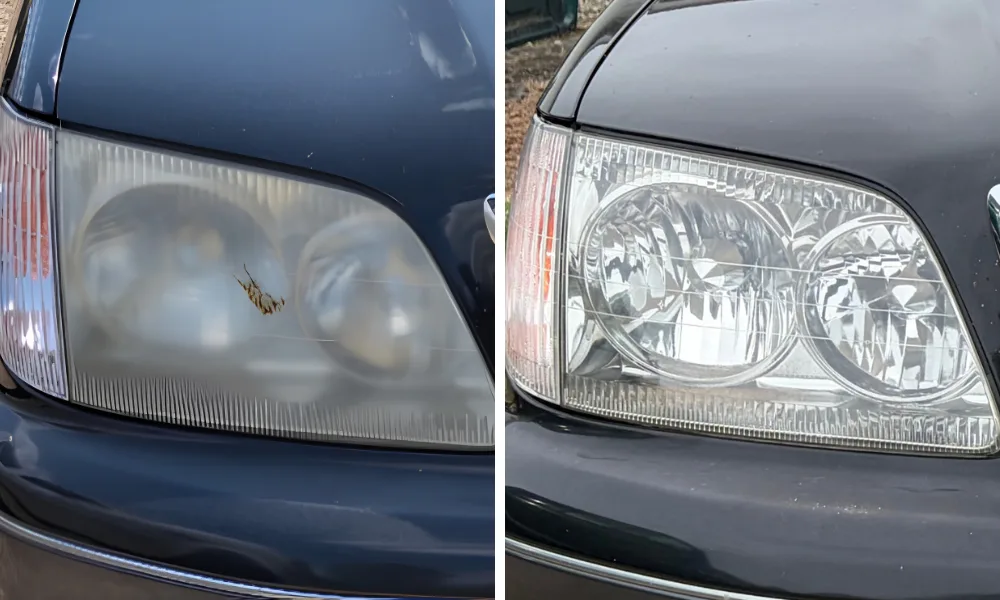
- Restore oxidized headlights. After years of New England sun and salt spray, a hazy lens can rob you of a large share of your beam exactly when your eyes need every lumen. Restoration returns the lens to factory clarity for $269 a pair, about an hour in your driveway.
- Clean the windshield, inside and out. The interior film that builds up on glass scatters oncoming light into glare. This is free and most people skip it.
- Check your wipers and washer fluid. Massachusetts law requires headlights whenever your wipers run, so rain and snow driving is headlight driving, and streaked glass multiplies glare.
- Ask your eye doctor about night specific correction. Anti reflective coatings help many drivers, and cataracts, very common and very fixable, mimic every symptom above.
Why do headlights come first?
Because the aging eye problem is a light supply problem, and headlights are the supply. You can’t make your pupils younger, but you can stop your lenses from throwing away the light your eyes need. Our full restoration removes the oxidized layer entirely and seals the lens with a bonded ceramic UV barrier, so the fix holds up through the same winters that caused the problem. We come to you anywhere in Greater Boston, you don’t need to drive anywhere or wait in a shop, and it’s restored or it’s free.