Foggy headlights are most dangerous exactly where Greater Boston drivers put in their highway miles: Route 2 running west out of the city, I-495 around the outer belt, and the dark two lane roads that connect the towns in between. Here’s what hazy lenses actually take away from you at speed, and how to get it back.
How much sight distance do foggy headlights cost?
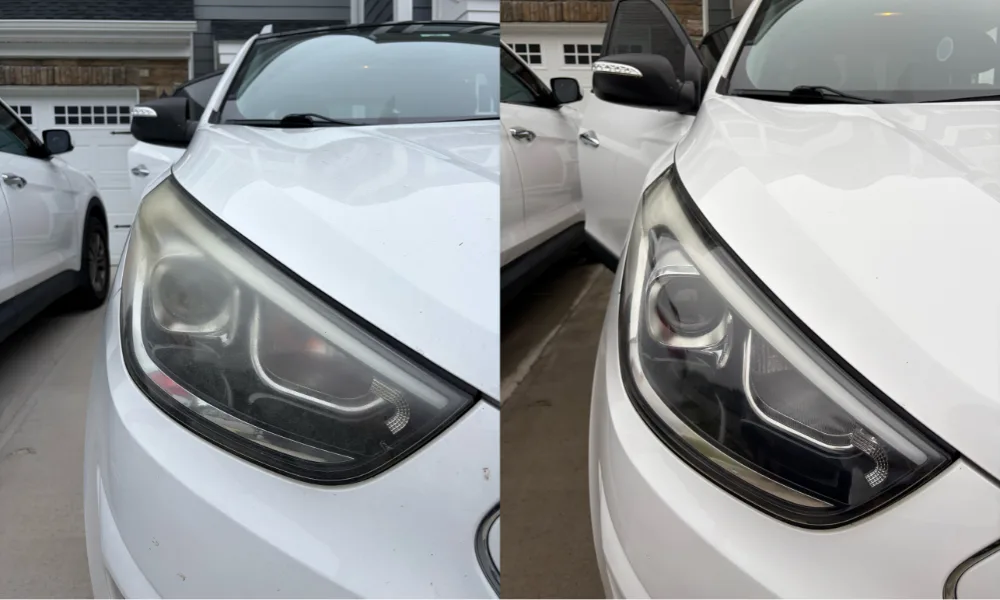
Enough to erase your reaction time. AAA lab tests found a badly hazed lens can deliver as little as 20% of the light a new one does. At 65 mph you’re covering 95 feet every second, so every foot of beam you lose comes straight out of your warning time. An oxidized lens scatters a large share of your light sideways into glow instead of throwing it down the road. Most drivers stop noticing how little they can see, because the haze builds slowly over years.
Why do Route 2 and I-495 make it worse?
Because both roads mix darkness, speed, and surprises in a way city streets do not.
- Route 2 west of 128 goes dark fast. The stretches through Concord, Acton, and Littleton have long runs with no overhead lighting, plus deer that don’t check for traffic. The Concord rotary rewards seeing brake lights early.
- I-495 is the classic outer belt problem: high speeds, long unlit rural stretches, and heavy truck traffic kicking up spray half the year. A stopped car on the shoulder near the Littleton or Bolton exits gives you very little warning if your beam is a dull glow.
- The connector roads, Routes 117, 119, and 62 through Stow, Bolton, and Harvard, have no streetlights at all. Out there, your headlights are the only light that exists, and stone walls sit close to the pavement.
Is it my eyes or my headlights?
Often both, and the headlights are the cheap half to fix. Night vision declines gradually with age, and so does lens clarity, at about the same slow pace, which is why neither gets noticed. If oncoming headlights seem harsher and your own lane seems darker than a few years ago, look at your lenses in daylight first. If they’re yellow or chalky, start there.
What actually fixes it?
Removing the damaged layer, not covering over it. Our full restoration wet sands the oxidized polycarbonate away completely, works the lens back to optical clarity, and bonds a ceramic UV barrier to the surface so the haze doesn’t come back after the next salt season. About an hour, at your driveway, anywhere in Greater Boston, any hour of the day or night. Restored or it’s free.