
Massachusetts is hard on headlights from two directions at once. Summer sun breaks down the factory coating, and winter salt grinds away at whatever is left. Here’s what’s actually happening to your lenses, why it happens faster here than drivers expect, and what stops it.
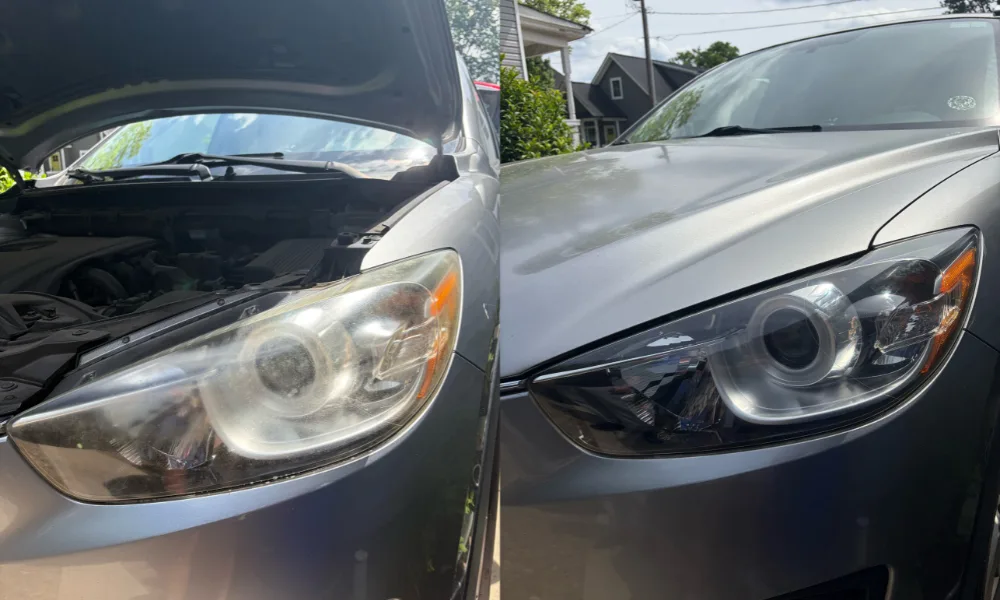
Why do headlights turn yellow and cloudy?
UV light breaks down the factory coating on the lens, then attacks the plastic underneath. Every modern headlight lens is polycarbonate, a plastic chosen because it’s nearly shatterproof. The tradeoff is that bare polycarbonate is extremely vulnerable to UV, so manufacturers spray a thin protective coating on every new lens. That coating is the only thing standing between the sun and the plastic, and it’s engineered to a price, not to a decade of New England weather.
Once UV eats through the coating, the polycarbonate itself oxidizes. The surface turns chalky at a microscopic level, scattering light instead of passing it. You see it as haze, then yellowing, then a lens that looks boiled. Your headlights didn’t get dimmer inside; the light is being blocked and scattered at the surface.
Why does it happen so fast in Massachusetts?
Because the damage never gets an off season. Summer does the UV work: lenses bake in commuter lots and driveways all day, and July sun at highway speed heats the plastic while it’s being hit. Then winter takes over. Massachusetts spreads roughly half a million tons of road salt in a typical season, and every mile behind a plow or a salt truck sprays your lenses with grit and brine. That spray works like slow sandblasting on a coating the sun already weakened, and the freeze and thaw cycle opens microscopic cracks for the next round.
Add the local reality that most cars here live outside. Street parking in Cambridge and Somerville, open commuter lots at Alewife and the 495 park and rides, driveways with no garage. A lens that might last a decade in a mild climate can start hazing here in a few years.
What does oxidation actually cost you?
Light, money, and your inspection sticker.
- Light. A heavily oxidized lens can block or scatter most of your usable beam. AAA lab tests found a badly hazed lens can put out as little as 20% of what a new one does, and that loss lands hardest on unlit roads after our 4 pm winter sunsets.
- The sticker. Massachusetts inspects every vehicle every year, and the inspection rule says lenses must be clean, unobstructed, and free from cracks. Heavy haze puts your sticker at risk. We cover the rule in detail in our post on failing inspection.
- Money. Left alone, the only factory fix is replacement, which costs many times what a restoration does. Cloudy lenses also mark down what a dealer offers when you sell or trade the car.
Can you prevent it?
You can slow it, and after a proper restoration you can effectively stop it. Parking in a garage helps. Rinsing salt film off the front of the car through the winter helps. But the factory coating fails eventually under this cycle no matter what you do.
What changes the math is what goes on the lens after restoration. Our process removes the oxidized layer completely with grit matched wet sanding, then seals the fresh surface with a ceramic coating that chemically bonds to the polycarbonate. Unlike the wipe on sealants in DIY kits, there’s no film sitting on the surface for the salt to strip away. That bond is why we can back the work with a 3 year warranty, or lifetime coverage on our Crystal Clear for Life package, in a state that throws sun and salt at every lens.
What should you do if your lenses are already hazy?
Restore them before the damage goes too deep. Restoration works as long as the damage is in the lens surface, which covers nearly every cloudy headlight out there. The full restoration process takes about an hour at your driveway anywhere in our Greater Boston service area, costs a fraction of one replacement assembly, and comes with a simple promise: restored or it’s free. Pricing for all three packages is on the pricing page.