
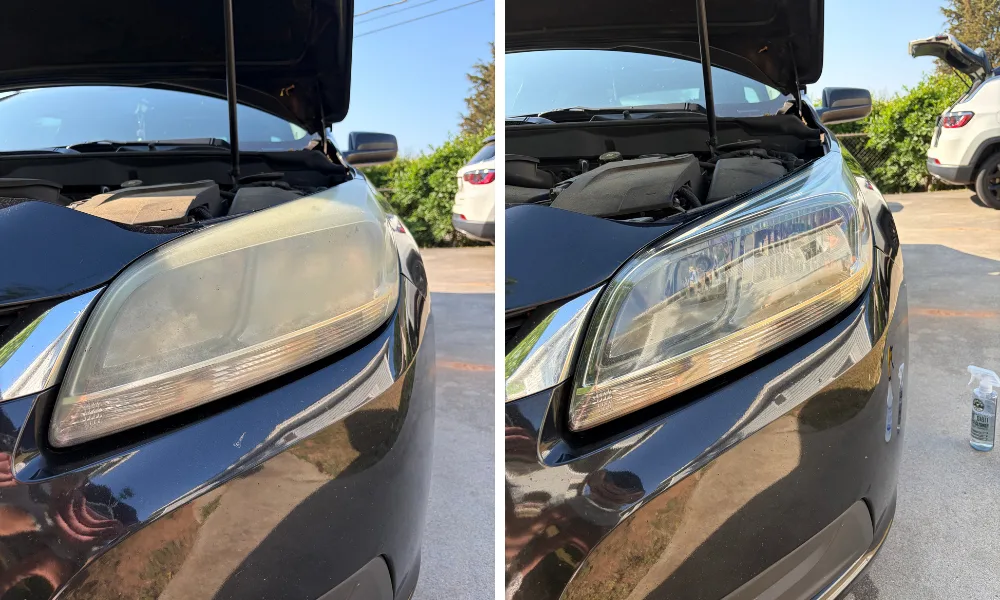
Gig drivers in Greater Boston put on more night miles in a month than most commuters do in a year, on unfamiliar streets, watching for house numbers instead of the road. Your headlights are working equipment, and if they’re hazed over, they’re failing you on the clock. Here’s the case for treating them like the business expense they are.
Why are gig drivers the highest risk group for headlight problems?
Volume and conditions. Surge hours and dinner rushes concentrate after sunset, and from November on, sunset lands before 4:30 around here. Delivery routes end on residential streets with weak lighting, in Lowell, Framingham, and the older blocks of Waltham, where you’re scanning for addresses while pedestrians and pets cross dark streets. And the miles themselves age your lenses faster: a full time driver’s car sits outside all day between rides soaking up UV, then spends the winter eating salt spray on 495 and the Pike. The usual haze timeline compresses when the car lives outdoors and works nights.
What does the liability picture look like for a working driver?
Sharper than for a commuter. Massachusetts requires headlights whenever your wipers run under MGL Chapter 85 Section 15, and the annual inspection rule requires lenses that are clean and unobstructed, so a working car with hazed lenses is exposed on both fronts. A night crash while working triggers questions a private driver never faces: rideshare insurance tiers, company deactivation policies, and in a serious case, whether your equipment met the legal standard. Visibly oxidized lenses are the kind of detail that gets photographed after a crash. A $269 fix is cheap insurance against that conversation.
Do headlights really affect ratings and earnings?
Indirectly but genuinely. Passengers judge the car in the first five seconds, and at night the first thing they see is the front of it, lit by its own headlights. Clean, clear lenses read as a maintained car; yellow ones read as a beater before the door opens. More directly: drivers with degraded lights slow down on dark streets, hunt for addresses longer, and finish fewer deliveries per hour. Light is throughput.
When is a gig driver supposed to find time for this?
You don’t have to find time, which is the point of how we built the service. We’re mobile and open 24/7, so the restoration happens in your driveway after you log off, at 1 am if that’s when your shift ends. About an hour, both lenses, done while you eat. The full restoration is $269 with a 3 year warranty, the Crystal Clear for Life package at $369 covers the lenses for as long as you own the car, worth a look on a high mileage vehicle, and both carry the same terms: restored or it’s free. A $169 Basic Restoration covers the same work without the warranty or guarantee.
Track your expenses? Keep the receipt. Vehicle maintenance for a gig vehicle is generally deductible; ask your tax preparer.