
Massachusetts law is blunt about bad weather: wipers on, headlights on. That rule has been on the books since 2015, and it means your headlights are legally required equipment through every rainstorm, snow squall, and slush commute of the year. Hazy lenses fail hardest in exactly those conditions, and here’s why.
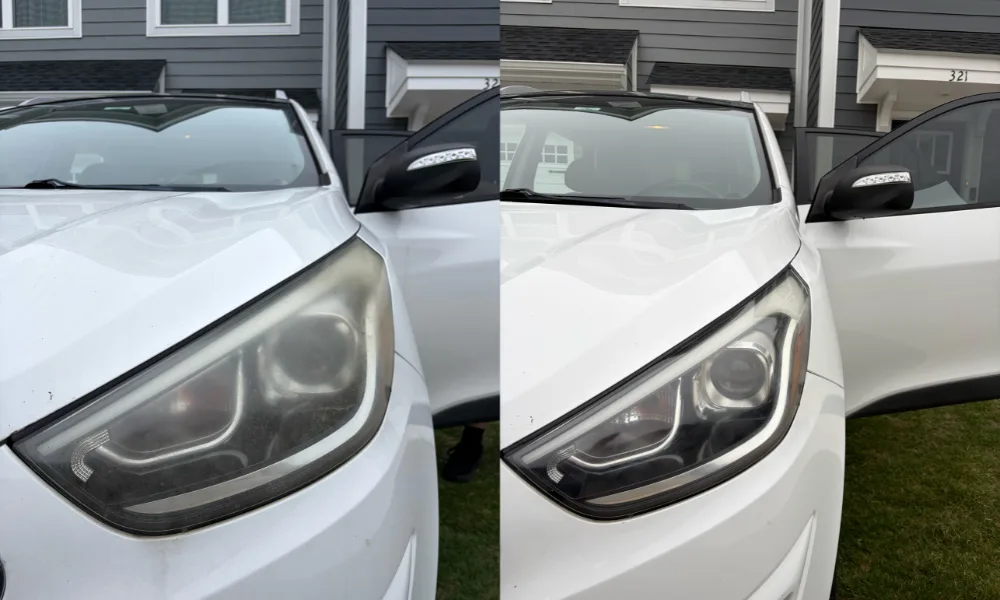
What does the law require?
MGL Chapter 85 Section 15 requires headlights and taillights in three situations: from a half hour after sunset to a half hour before sunrise, whenever visibility drops below 500 feet, and whenever your windshield wipers are needed. That last clause is the one that catches people. Every gray drizzle on Route 128, every squall on I-495, every slushy school run is a legal headlight event. A ticket for it no longer surcharges your insurance, but it’s still a stop, still a fine, and still a sign your worst equipment was on duty.
If your lenses are heavily oxidized, the math is uncomfortable: you’re running your dimmest possible light during the exact conditions the law exists for, dozens of times a season.
Why is glare worse in rain and snow?
Water multiplies scatter. A clear lens throws a focused beam pattern with a sharp cutoff. An oxidized lens already scatters light in every direction, and precipitation adds more layers: a film of water on the lens diffusing the beam again, a wet road bouncing every stray ray back up, and in snow, millions of flakes lighting up like a wall in front of you. The result is the winter driving experience every Massachusetts driver knows, a glowing gray curtain where the road should be, while oncoming drivers squint at the glare your scattered beam sends their way.
That last part matters more than most people realize. Hazy lenses don’t just light your road worse, they blind other drivers more, because light that should point down and right sprays everywhere instead.
Why does winter also accelerate the damage?
Salt season is sanding season for your lenses. Massachusetts spreads roughly half a million tons of road salt in a typical winter, and highway spray carries it straight onto your headlights at 65 mph, grinding at the factory coating like fine abrasive. The freeze and thaw cycle works on the weakened surface between storms. Then summer UV bakes whatever the salt roughed up. Lenses that looked passable in November are often visibly yellow by April. The full breakdown of that cycle is in our post on why Massachusetts headlights cloud over.
What’s the fix before the next storm cycle?
A real restoration, done before the damage deepens. We remove the oxidized layer entirely with grit matched wet sanding, restore optical clarity, and seal the lens with a ceramic coating that chemically bonds to the polycarbonate, so next season’s salt spray hits the barrier instead of the plastic. It takes about an hour in your driveway, we work around weather windows because we’re open 24/7, and every job carries the Restored or It’s Free guarantee.